Accommodation
Rooms, stay options, dates, rate inclusions and arrival policies.
Hospitality
A hospitality website sells both an impression and a practical choice: what is offered, what the place looks like, what it costs, where it is and how to book or enquire.
Atmosphere · Space · Experience
A strong hospitality website has to do both.
The central tension
Move the balance with the arrow keys or pointer. This is not a choice between layers: the structure must answer the right question as interest turns into a decision.
At the centre is a connected journey: the character of the place leads to verifiable details and a next action.
Guest journey
The order depends on the venue and the context of the visit. We test whether guests can move through it without guessing.
See the character of the place and decide whether to continue.
Learn what the business actually offers and who it suits.
Compare rooms, services, packages, rates and restrictions.
Check photography, terms, policies and real practical detail.
Find the address, route, parking and arrival information.
Move into an external booking service or direct enquiry.
Content model
Not every property needs every item. The page follows the actual offer, not a hotel template.
Business model
Architecture starts with what the business actually sells.
Rooms, stay options, dates, rate inclusions and arrival policies.
Bathhouse, spa, retreat, event or leisure scenario with duration and terms.
Accommodation plus treatments, activities, food or packages without mixing distinct paths.
Booking architecture
We do not present the website as a proprietary booking engine. The job is to connect the offer, date and terms clearly to the existing booking route.
Form, phone or email when a person confirms availability.
A link or embedded integration with an existing booking service after reviewing its capabilities.
Direct enquiry and an external service for different situations.
Rates and packages
This is a generic demonstration, not client pricing. We present the existing rate model; we do not promise a dynamic pricing engine.
| Model | What changes it | How to explain it |
|---|---|---|
| Room type | category and occupancy | what the option includes |
| Period | weekday, weekend, season | explicit dates and rules |
| Package | services and add-ons | included / excluded |
| Restrictions | minimum stay | the condition beside the rate |
Visual content
Photography should communicate character and help verify a choice.
Location
On mobile, an address is not enough. Guests may need a route, parking, landmarks, transport, entrance and check-in detail — only where relevant.
Address
route · landmark · entrance
Arrival
parking · check-in · contact
Mobile journey
Production proof
We show only verifiable interface decisions, with no claims about booking growth, conversion, SEO or revenue.
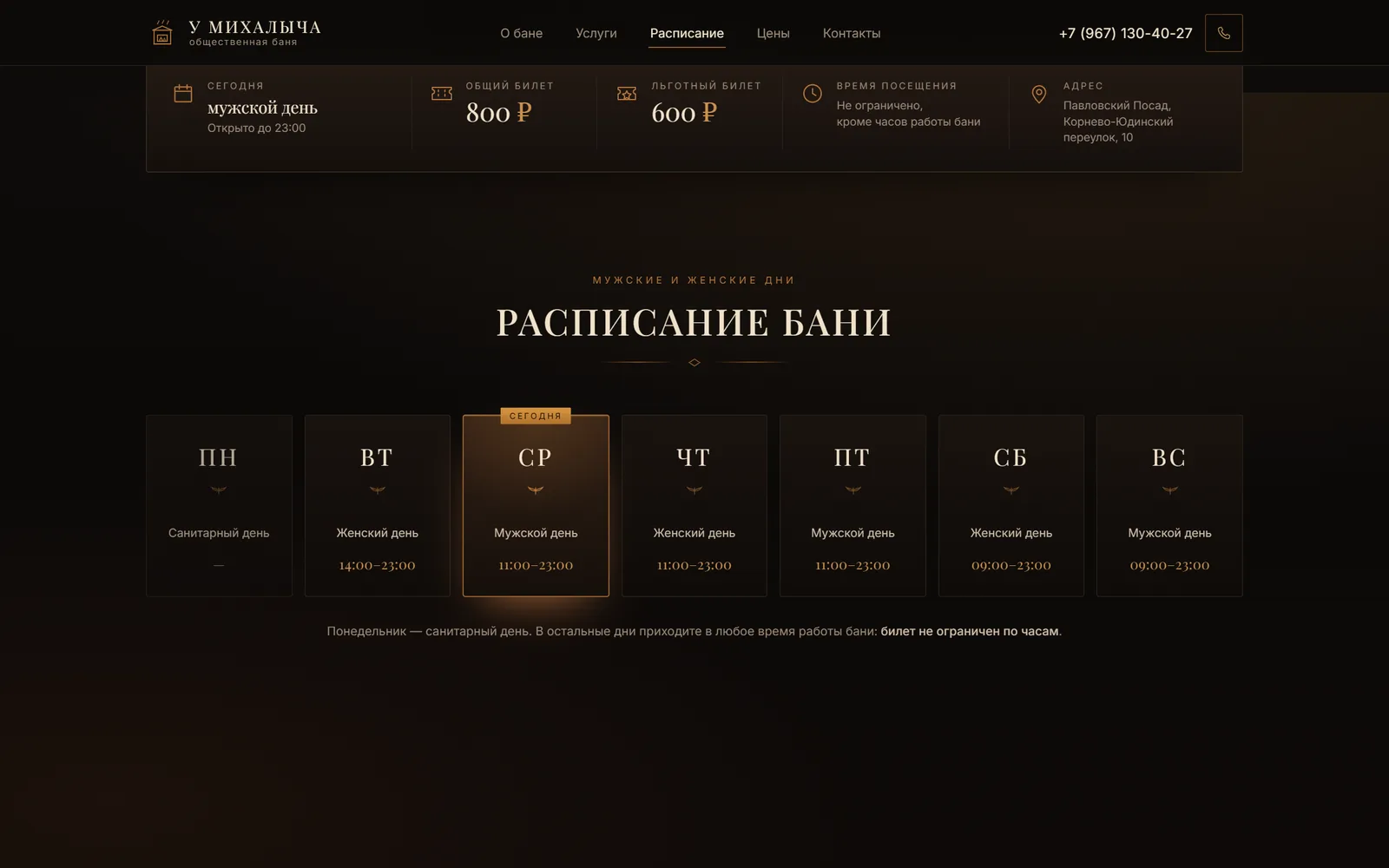
A local leisure venue with current status, schedule, price, address, call and directions in a short mobile journey.
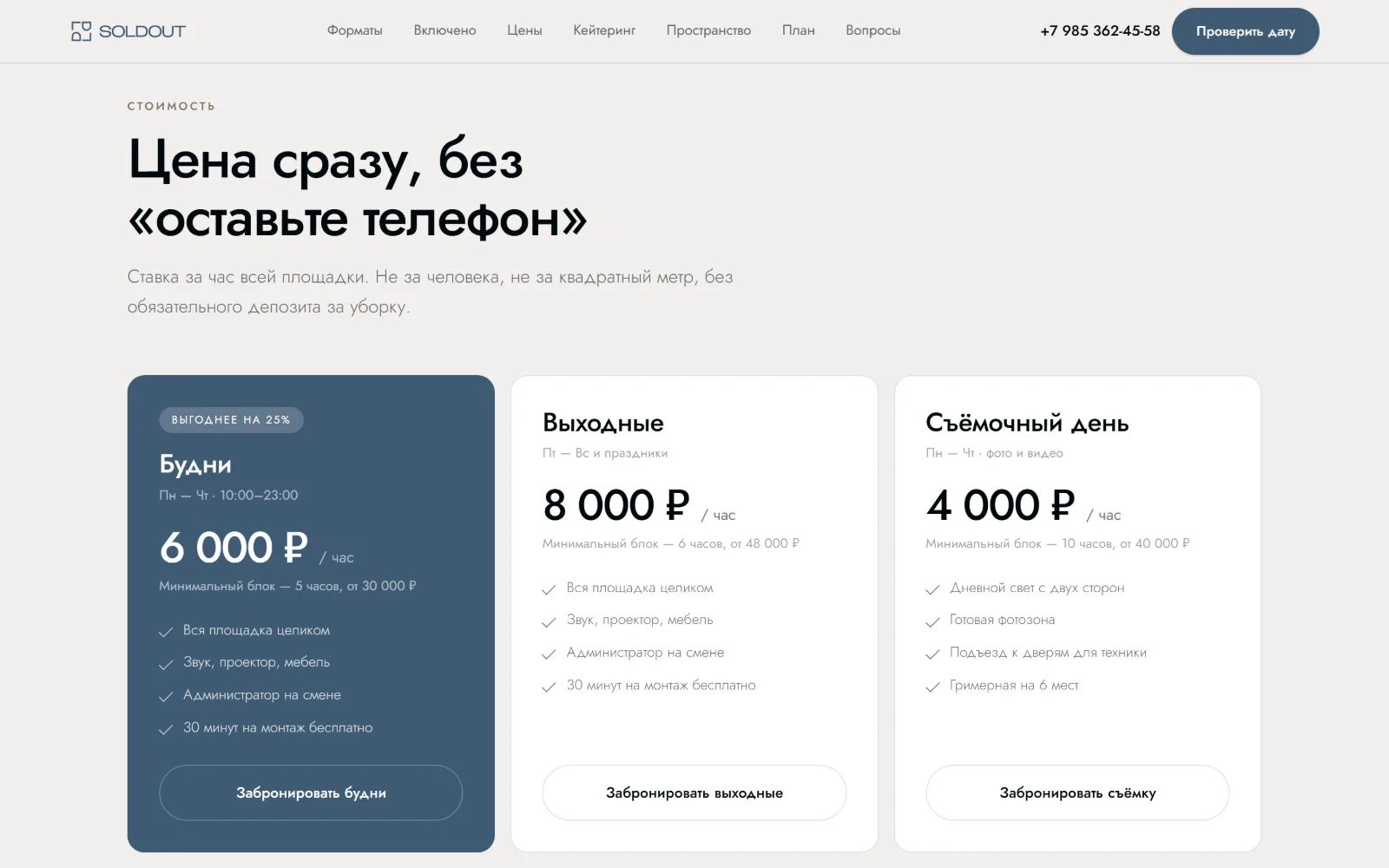
An event venue with formats, open hourly rates, terms, a measured plan and a route to checking a date.
The right engagement
We start with the situation instead of selling the same package to everyone.
Content system
These types can be reused across the site. A CMS is optional when rooms, packages, offers or policies genuinely change often.
One page serves one real intent: a room, service, package, location or useful question. No mass generation or keyword stuffing.
We localise URLs, metadata, hreflang and content, with currency or policy differences where relevant. Automatic translation is not treated as localisation.
Responsive images, modern formats, lazy loading and considered video preserve visual quality without unnecessary payload or heavy autoplay.
Process
Map of products and constraints
Selection and action scenarios
Prototype and content types
A system for atmosphere and information
Agreed route and integration requirements
Responsive production interface
Tested journeys, SEO foundations and handoff
FAQ
Not necessarily. Direct enquiries or an existing external service suit many businesses. A proprietary booking engine is not included without separate discovery and a confirmed need.
Often yes, through a link or a considered embedded integration. We first review the service, mobile journey, analytics and technical constraints.
Yes. We design separate URLs, language switching, localised metadata and hreflang. Translation and editorial review are scoped separately.
Yes, if it is sufficiently strong and cleared for use. We begin with an inventory and can help define a shot list if material is missing.
Not always as one exact number, but guests need a clear model: a range, starting point, estimate factors, packages or a quick route to a relevant quote.
Yes, this is a normal redesign requirement. We map URLs, metadata and redirects, but do not promise specific rankings because external factors also affect them.
Show it to us in an audit. We will identify where atmosphere, practical detail and action disconnect, and whether a rebuild is justified.
Only when content changes regularly and the team needs to manage it. A CMS may add needless complexity to a small, stable website.
Start with context
Tell us what guests can choose, how enquiries or bookings work today and what content already exists.