Do you do this?
A focused service page or section explains the work, the useful outcome and the boundaries of the offer.
Websites for service businesses
Questions before contact
Choose a question to see the website element that should remove the uncertainty. This is a completeness check for the journey, not a universal template.
Do you do this?
A focused service page or section explains the work, the useful outcome and the boundaries of the offer.
Is it right for me?
Scenarios, constraints and examples let people recognise their situation without calling for basic clarification.
How much is it?
A fixed price, a starting point or transparent estimate factors explain the model even when the final figure depends on scope.
Where do you work?
The address, areas, cities or travel radius appear where a visitor is making the decision.
When are you available?
Opening hours, available slots or a clear scheduling process remove another unnecessary enquiry.
Can I trust you?
Real photography, people, work, process and verifiable terms appear before the primary action, not after the form.
What do I do next?
The call to action matches the business model: call, enquiry, booking, directions or quote request.
Mobile-first reality
Someone may open the website while travelling or just after a recommendation. On a small screen, information order matters more than decorative scale.
Recognise the service and format
Pricing, terms and availability
Location, coverage and proof
Call, form, directions or booking
One page or many
Switch formats to compare the fit. A multi-page structure is useful when services genuinely need separate journeys and search intent, not simply because bigger sounds better.
One focused journey
Several distinct journeys
Service architecture
This is an example pattern for a business with several services. The real map may be shorter or deeper after we review the offer and demand.
Home
An architecture example, not a required sitemap.
Pricing clarity
The right model depends on how standardised the service is and what information is needed to estimate it.
For a repeatable service with clear limits.
One figure + what is included
For a known baseline with variable scope.
Starting point + estimate factors
When the object, condition or task shapes the price.
Inputs required for an estimate
The website should explain the pricing logic and next step, not force every service into a single figure.
Trust before contact
For a service business, trust is usually more immediate and personal than on a corporate website.
We do not invent reviews, awards, guarantees or certificates to fill a section.
Where do you work?
A visitor needs to know quickly whether the business can serve them.
Address, hours and directions
Separate, real locations
Radius, cities or areas
Clear delivery conditions
The structure communicates service-area facts; it does not promise rankings in maps or local results.
Conversion architecture
Not every service belongs in the same generic form. We choose a primary and fallback action after understanding the operating process.
When an answer is needed now
When a short brief is useful
When slots and booking rules exist
When parameters are needed first
For a physical location
When the channel is actively managed
Channels and integrations are included only when relevant and agreed in scope.
Friction audit
Choose a problem to see how one clear answer shortens the journey. The essential meaning remains available without motion or hover.
Unclear service
Is this even relevant to my task?
A concrete offer and clear limits
Real project proof
Both projects are live in production. We show only what can be verified in the websites and case material, with no claims about leads, revenue growth or rankings.
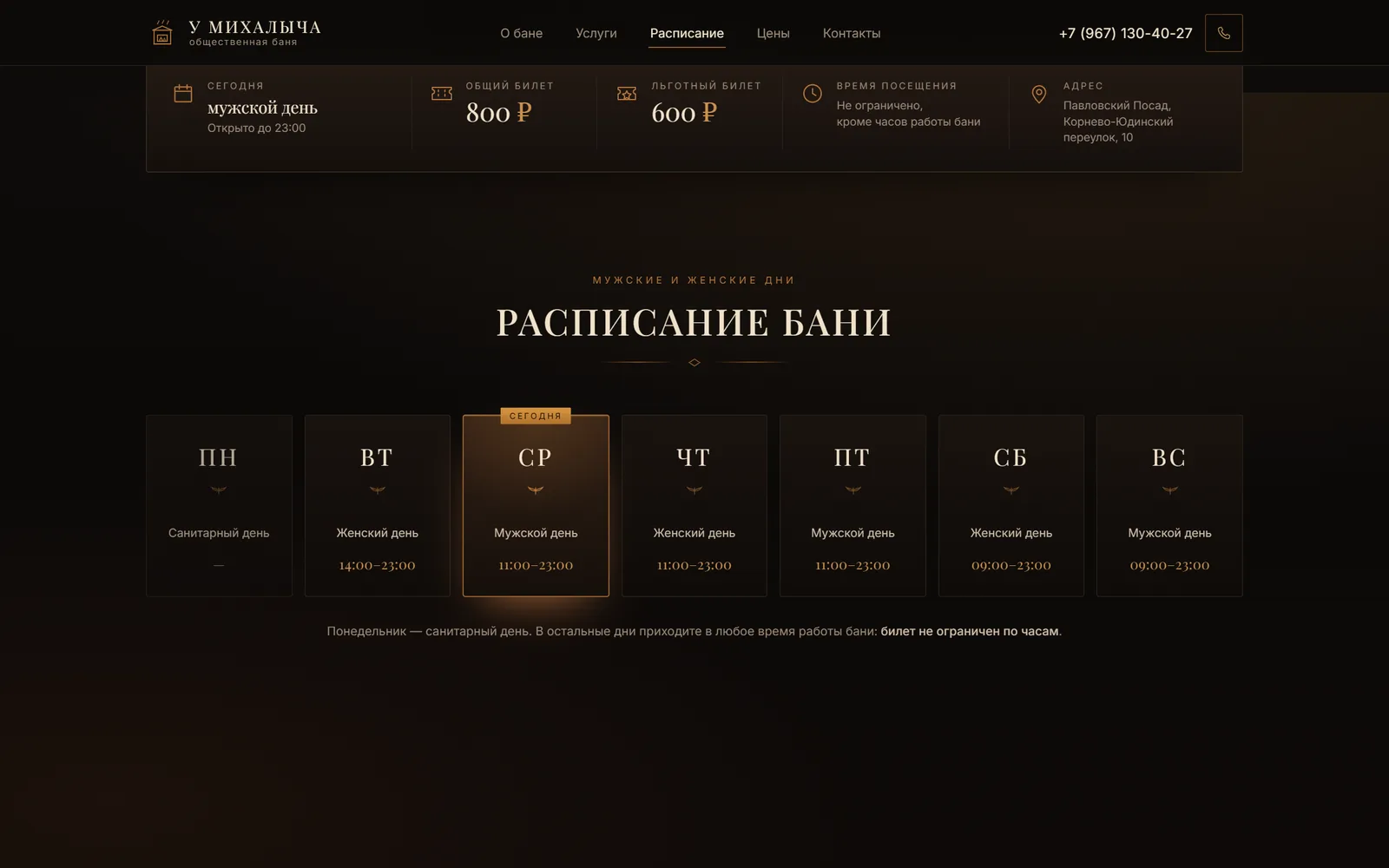
Production project
A local service where the decision depends on opening hours, price, location and a fast mobile action.
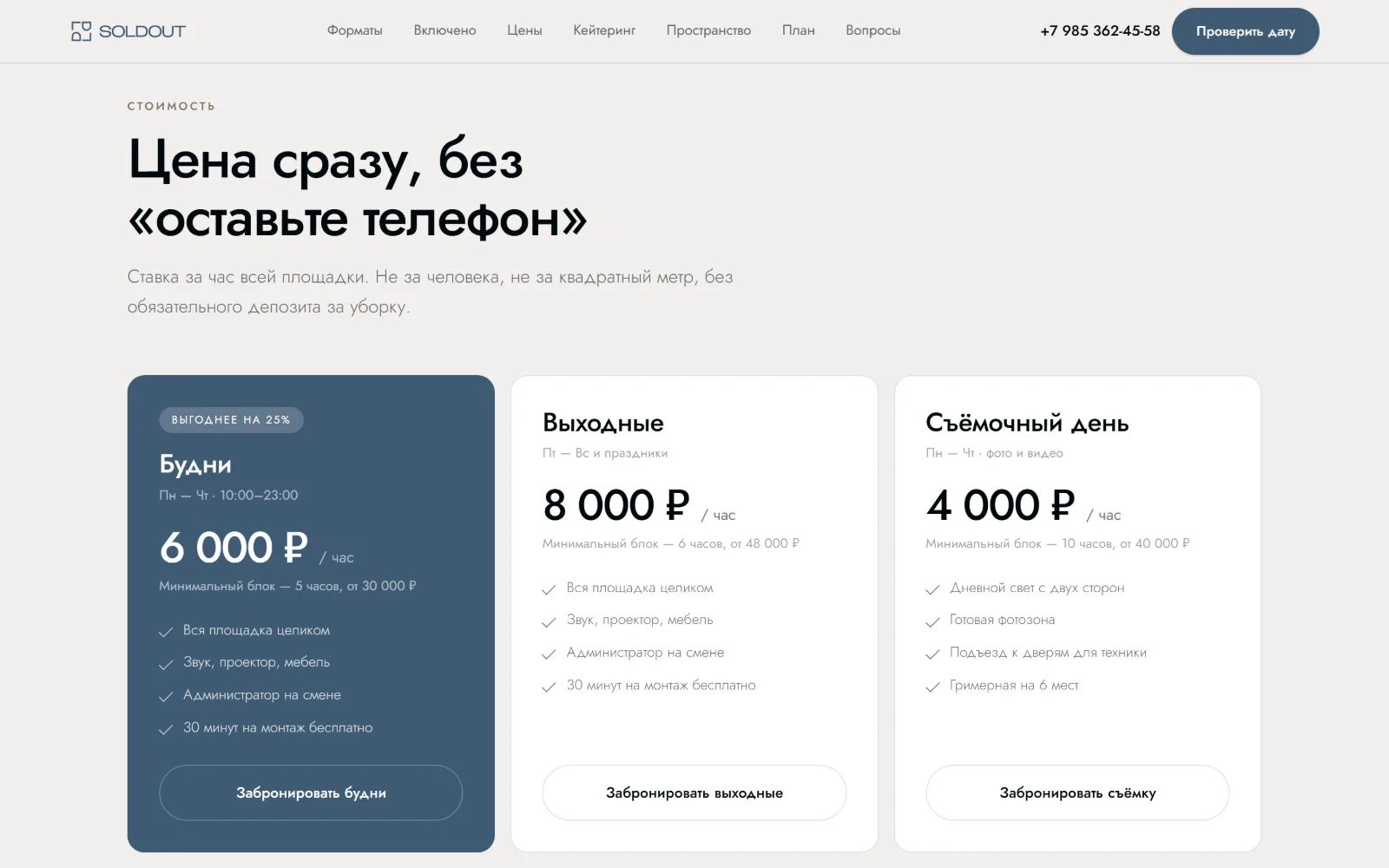
Production project
A venue booking journey with event formats, an open hourly rate, terms and one route to checking a date.
Service website process
→ Visitors immediately understand what you do
→ Every important service receives a place
→ The shortest useful route to action is defined
→ The hierarchy of key screens is tested
→ Trust and character share one language
→ The responsive interface works in production
→ Journeys, SEO foundations and handoff are checked
What is included
The final set depends on the agreed structure and the business infrastructure.
SEO layer
When service lines are genuinely distinct, dedicated pages help people and search engines understand them more precisely. That is not a reason to publish empty pages for every phrase.
/services/cleaning//services/repair//services/maintenance/For a local business, the name, address, contact details, service area and opening hours should agree wherever they matter on the website.
The URLs illustrate a principle and are not new EO Labs routes. We do not promise Maps rankings.
Related directions
FAQ
A landing page fits one primary service, audience and action. Several distinct services, locations or search intents usually need a multi-page structure. We decide after mapping the offer and visitor jobs.
Not always an exact figure. The website can show a fixed price, a starting point, or explain the factors behind an individual quote and the information required to prepare one.
Yes, when the selected system fits the operating process and the integration is included in scope. We review the journey, connection options and personal-data handling before estimating it.
Yes. The existing domain is normally retained; before launch we check DNS, current URLs, email and other dependencies and prepare the switch.
We inventory URLs and content, prepare content and redirect maps, migrate metadata, and verify canonicals and sitemap. This reduces risk but cannot guarantee rankings.
Only if the team regularly changes services, pricing, hours, locations or other information. For infrequent updates, a separate CMS may be unnecessary.
Yes. We identify the rules and assets that already work and adapt them to the digital interface. Any missing art direction is agreed as a separate scope.
Start with an audit of the offer, structure, mobile experience, trust, pricing, coverage and actions. The evidence will show whether focused changes or a full redesign make sense.
Next step
Share the current website or describe the services, coverage and how enquiries are handled. That is enough to begin mapping the structure.