Planning
Landing page or multi-page website: choosing a format
You can put ten services on one page. The buyer still has to work out which one solves their problem. That is where the choice of website format starts.
A landing page suits one main offer and a shared buyer journey. Separate pages help when services, buying conditions or audience questions differ. A campaign landing page can also sit within a larger website.
Start with the questions buyers ask
Look at three recent enquiries and write down what people needed to know before buying. Avoid starting with page labels such as About and Services. Write the questions instead: do you support our equipment, do you cover our area, can we start without a specification, who maintains the result?
If the answers form one continuous conversation, a landing page may be enough. Emergency repair, scheduled maintenance and system design have different buying conditions. Combining them into one long page makes each visitor search for their own fragment.
A landing page can still link to separate policy or documentation pages. Here, the term means one principal page presenting the offer, rather than a literal limit of one URL.
When one page is enough: a portfolio example
For the Banya u Mihalycha public bathhouse project, the main questions concern one visit: which session is running today, when it opens, what a ticket costs and how to get there. We brought the schedule, prices and contacts onto one page. A visitor can plan a visit without navigating between sections.
This illustrates a structure matched to a task. It does not mean every local business needs only a landing page. Separate products or different service conditions can require a different conversation with the visitor.
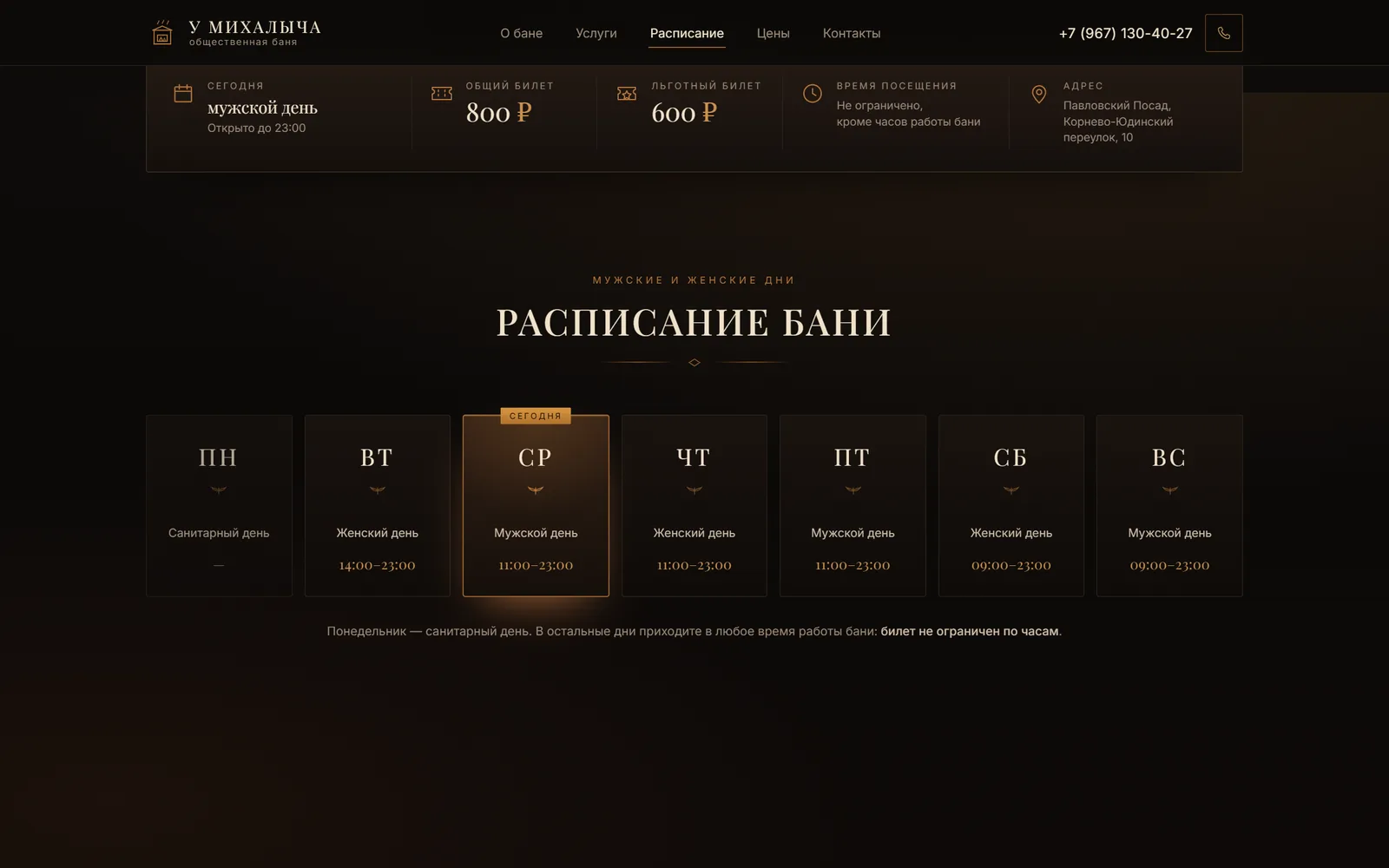
A project detail: visit conditions and the timetable share the same page flow. The screenshot shows the original Russian website.
Explore the projectAn example: three services, three buying situations
Imagine an air-conditioning company offering installation, repairs and maintenance. Installation buyers compare equipment and the work included. Repair customers want the service area, diagnostic process and a quick way to contact someone. Office maintenance buyers need contract terms, schedules and supported systems. This is a hypothetical example, not an EO Labs client case.
Separate service pages would let each group find the relevant information. The homepage can explain the business and its coverage. A seasonal installation offer could then have a campaign landing page on the same website.
Scroll the table horizontally
| Situation | Starting format | Check first |
|---|---|---|
| One service with shared terms | Landing page | Can it answer the questions people ask before enquiring? |
| Different services and reasons to buy | Separate service pages | Is there distinct information for each service? |
| One product for several audiences | Core website plus audience pages | Do the terms and content actually differ? |
| A campaign for an established business | Landing page within the website | Do the advertisement, offer and enquiry form agree? |
What the format changes for search
A landing page has one principal URL and topic. It can appear in search; single-page websites are not inherently unindexable. The limitation is trying to answer several substantially different searches in depth on the same page.
Installation and repair pages can have their own titles, conditions, examples and contact journey. Ten pages that only swap a service or city name do not provide the same value. Before adding a URL, identify what the new page will help someone understand.
Search engines need accessible URLs and ordinary links between pages. A sitemap helps them discover those addresses. Neither a page count nor a sitemap guarantees indexing or rankings.
Page count is a weak guide to cost
A landing page with bespoke artwork, complex interactions and a form integration may take more work than several pages using shared templates. A price comparison based only on the number of pages leaves out much of the project.
Ask for the scope of architecture, content, design, development, integrations and launch checks. Establish who will update prices and add services: an editor using a CMS or a developer on request. That decision affects both implementation and ongoing costs.
Bring a draft journey to the first discussion
Bring your services, sample enquiries and expected traffic sources. Sketch what a visitor sees first, where they get answers and how they contact you. This lets you check the format before investing in design.
If demand for individual services is still uncertain, begin with a modest set of pages. Discuss future URLs, navigation, a service template and editing. Expanding later may still require changes; establish those constraints before commissioning the first version.
- Which offers have different conditions or audiences?
- What must someone know before contacting you?
- Where should each campaign send its visitors?
- What content is available for separate services?
- Who will maintain the site after launch?
Further documentation
Planning a website for several services?
Share your services and the questions customers ask. We can discuss the initial pages and what to add later.